Key Takeaways:
- Five9 revenue optimization is the practice of reconfiguring your existing Five9 deployment so it measurably contributes to pipeline and revenue, not just to lower handle times and cleaner service metrics.
- Most contact centers underperform on revenue because they were configured around efficiency KPIs, and nobody ever redefined what success means in dollar terms.
- Revenue leaks are usually structural, not effort-related: generic routing, disconnected CRM data, untrusted dispositions, and no attribution model linking conversations to closed revenue.
- Five9 features like intelligent routing, predictive dialing, IVR containment, and Agent Assist only produce revenue when they are configured against a defined revenue objective.
- Integration quality is the foundation. If your CRM data and disposition hygiene are unreliable, no routing or automation change will hold.
- Start by auditing the revenue metrics you can actually produce today, before you change a single setting in the platform.
Your contact center already talks to more high-intent buyers than any other team in your company. Yet in most organizations, that same contact center is measured entirely on cost: average handle time, occupancy, abandonment, cost per contact. The revenue those conversations create, protect, or lose never appears on the dashboard.
Five9 revenue optimization closes that gap. It is the deliberate work of reconfiguring routing, dialing, automation, integration, and reporting inside your existing Five9 environment so the platform is measured and tuned on revenue outcomes.
This guide covers what revenue optimization actually involves, where revenue leaks in a typical deployment, which Five9 features move the needle when configured correctly, which metrics you should be tracking instead of the ones you probably are, and the mistakes that quietly cap your results.

What is Five9 Revenue Optimization?
Five9 revenue optimization is the process of aligning your Five9 configuration, data, and reporting around revenue metrics such as conversion rate, revenue per contact, and customer retention, rather than around efficiency metrics alone. It treats the contact center as a commercial function with measurable revenue output, and it tunes the platform accordingly.
That distinction matters more than it sounds. A standard Five9 optimization project asks whether the platform is running well. A revenue optimization project asks a harder question: is the platform producing more money than it did last quarter, and can you prove it?
The second question forces changes the first one never surfaces, including how calls are prioritized, which conversations get a human, and how outcomes are written back to your CRM.
Build a Revenue-Focused Five9 Roadmap With Expert Support
Most teams know their Five9 setup could do more. What is harder is knowing which change to make first, and what it is realistically worth. That prioritization is the core of a focused engagement.
A Five9 revenue optimization engagement typically starts with a configuration and data audit, defines the revenue metrics your business should be managing, then sequences the routing, integration, automation, and reporting work by expected impact and effort. You get a roadmap you can staff and defend internally, rather than a list of platform features you already own. Review the service page to see how the work is scoped and whether it fits your current stage.
Revenue Optimization vs. Cost Reduction
Cost reduction and revenue optimization pull in different directions more often than most teams expect. Shaving forty seconds off average handle time looks like a win until you discover the shortened calls were your highest-intent inbound sales queue, and conversion dropped alongside AHT.
Revenue optimization accepts that some conversations should take longer. It segments your contact volume by commercial value, then applies efficiency pressure where value is low and applies skill, time, and coaching where value is high. Cost reduction treats every contact as an identical unit of expense. Revenue optimization treats contacts as unequal, because they are.
Who Needs Five9 Revenue Optimization?
This work pays off fastest for organizations where conversations directly influence money. That includes inside sales and outbound teams running Five9 dialers, subscription businesses where retention and save rates drive lifetime value, high-consideration service categories such as insurance, healthcare services, home services, and financial services, and any growth-stage company whose contact volume has outgrown its original configuration.
If your Five9 instance was implemented two or more years ago, if your call volume or product mix has changed materially since then, or if you cannot currently report conversion rate by queue, you are almost certainly leaving revenue unclaimed.
Why Most Contact Centers Leave Revenue on the Table
Most revenue loss in a Five9 environment is structural rather than behavioral. Your agents are not underperforming; the system around them was never designed to produce or measure revenue in the first place. Original implementations are typically scoped to get calls answered, routed, and logged. That scope is reasonable at go-live and inadequate three years later.
The second cause is measurement. Teams optimize what they can see. When the only visible metrics are service-level metrics, every improvement effort bends toward service level, and revenue outcomes drift without anyone noticing.
The Five Most Common Revenue Leaks in a Five9 Deployment
- Value-blind routing. Calls are distributed by agent availability rather than by intent, account value, or agent conversion history. Your best closer takes a password reset while a renewal call waits in queue.
- Abandoned high-intent calls. Abandonment is reported as a service failure, not as lost pipeline, so nobody calculates its revenue cost or prioritizes fixing it.
- Broken or shallow CRM integration. Agents work without full account context, and outcomes never make it back to the CRM in a form that supports attribution.
- Unreliable disposition data. Too many codes, overlapping definitions, and no enforcement mean the outcome data you would need for revenue analysis cannot be trusted.
- No attribution loop. Conversations are never connected to closed revenue, so no one can tell which routing rule, script, or queue actually produced money.
How Five9 Revenue Optimization Actually Works
Revenue optimization follows a repeatable sequence. You can brief this internally as a project plan, and any competent consulting engagement should follow roughly the same order, because each step depends on the one before it.
Step 1: Baseline the current configuration. Document how calls actually flow today, which IVR paths carry the most volume, how queues and skills are defined, what dispositions exist, and which integrations are live. Most teams discover configuration nobody remembers building.
Step 2: Define revenue metrics and ownership. Decide what revenue success means for each queue, and assign a named owner for each metric. A metric without an owner is a report nobody reads.
Step 3: Fix the data layer. Clean up dispositions, repair CRM sync gaps, and confirm that contact records write back correctly. This step is unglamorous and non-negotiable.
Step 4: Redesign routing and dialing. Rebuild skills and routing rules around commercial value and agent capability. Adjust dialer pacing and list strategy for outbound teams so contact rates improve without inflating abandonment.
Step 5: Layer in automation deliberately. Deflect low-value, high-volume contacts to self-service and virtual agents. Keep high-intent conversations with humans, supported by real-time assistance rather than replaced by it.
Step 6: Build the measurement loop. Stand up dashboards and alerts that surface revenue metrics daily, then review them on a fixed cadence and iterate. Optimization is an operating habit, not a project with an end date.
The Five9 Features That Drive Revenue When Configured Correctly
Five9 ships with everything you need to run a revenue-producing contact center. The revenue does not come from owning the features; it comes from configuring each one against a specific commercial objective.
Intelligent and skills-based routing is the highest-leverage lever in most environments. Routing on value and proven agent performance, rather than on who is idle, changes conversion rates without adding headcount. Many of the underlying performance principles here overlap with the 7 proven strategies to improve contact center performance worth applying alongside revenue work.
Predictive and progressive dialing drives outbound revenue through contact rate and list discipline. Pacing that is too aggressive burns lists and inflates abandonment; pacing that is too conservative wastes agent capacity. The right setting depends on your list quality and compliance posture, not on a default.
IVR containment and self-service protects revenue by clearing low-value volume out of queues where high-value calls are waiting. The goal is not maximum deflection. It is accurate deflection, which is a design problem more than a technology problem.
Agent Assist and real-time guidance lift conversion by putting the right next sentence in front of the agent during the conversation. This is where automation compounds human performance instead of replacing it, and it is covered in more depth in the Five9 AI and automation guide to virtual agents and Agent Assist.
Virtual agents handle repeatable intents at any hour, capturing demand that would otherwise abandon overnight or on weekends. How that plays out in practice is worth reading in the context of AI-powered virtual agents and contact center customer experience.
Workflow automation removes after-call administrative work, which returns selling and service time to your agents. Workforce management and forecasting protect revenue by making sure your highest-value hours are actually staffed.
The Revenue Metrics Your Contact Center Should Actually Track
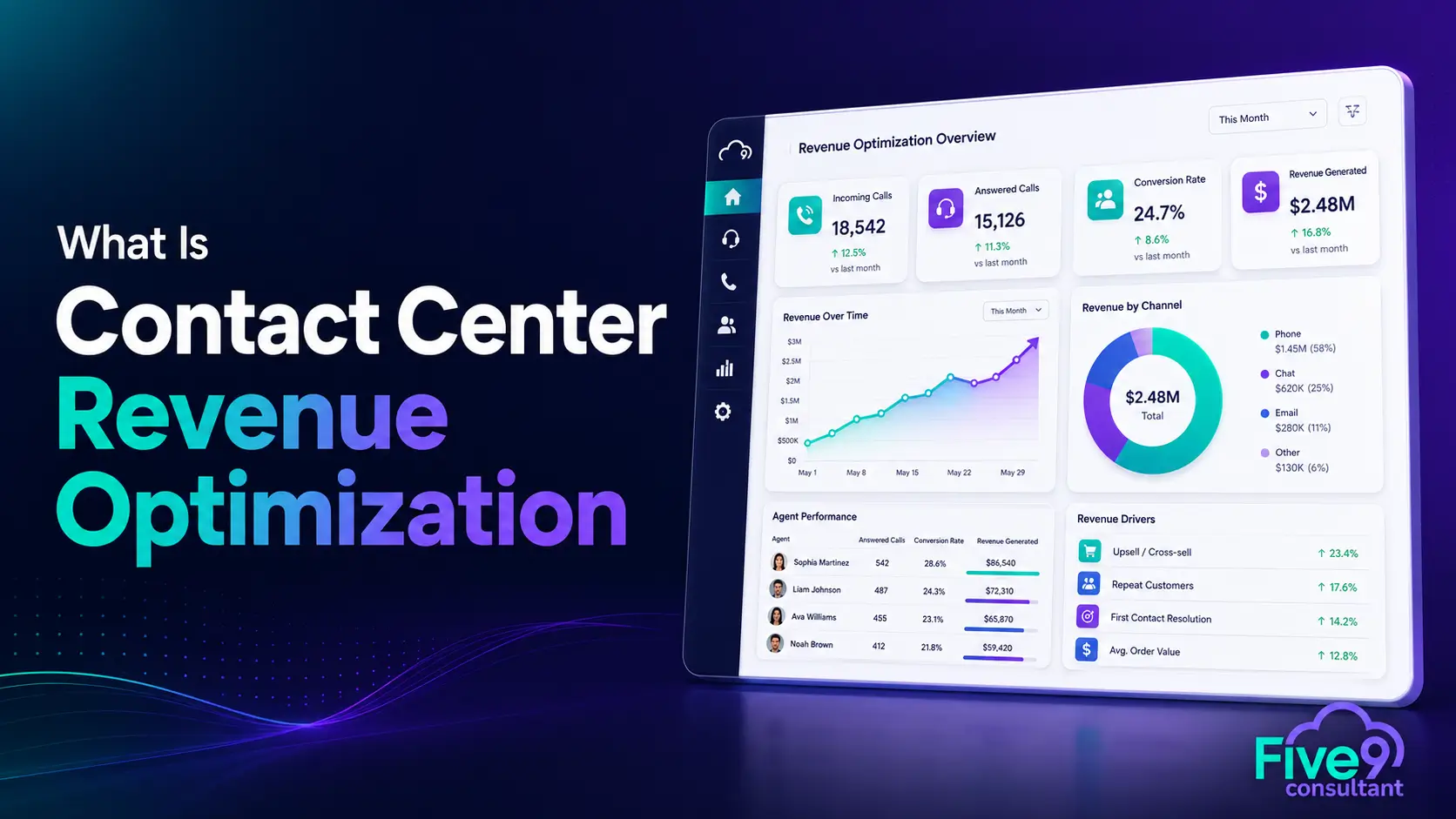
If your reporting stops at service level, AHT, and abandonment, you are managing a cost center. Revenue optimization requires a second layer of metrics that connect conversations to money.
- Revenue per contact, segmented by queue, channel, and campaign. This single metric reframes the entire operation.
- Conversion rate by queue and by agent. Agent-level conversion reveals coaching opportunities and routing opportunities simultaneously.
- Qualified opportunity rate. Volume alone is vanity; qualified volume is pipeline.
- Save and retention rate for any team handling cancellations, renewals, or downgrades.
- First contact resolution as a retention driver, not just a service score. Repeat contacts erode lifetime value.
- Customer lifetime value by acquisition source, so you can see which channels bring customers who stay.
- Cost per acquired customer, which is the honest version of cost per contact.
Building these requires two things: reporting configured to surface them, and CRM data clean enough to support them. Start with Five9 dashboards to monitor agent performance, then add proactive triggers using real-time call reports and alerts in Five9 so problems surface during the shift rather than in next month’s review.
Where you need external benchmarks to contextualize these numbers, pull them from Five9’s official documentation and resource library or from a research provider your team already licenses. Internal trend lines are more useful than borrowed averages anyway.
Why Integration is the Foundation of Five9 Revenue Optimization
No routing change, dialer adjustment, or automation rollout produces durable revenue if the underlying data cannot be trusted. Integration is the foundation, and it is where most revenue optimization projects either succeed quietly or fail expensively.
Three things need to be true. Agents need full account context at the moment of the conversation, which means a functioning screen pop with the right fields, not a partial record. Outcomes need to write back to the CRM cleanly and consistently, in fields your revenue team actually reports on. And conversations need to be traceable to closed revenue, which requires a deliberate attribution model rather than an assumption.
The Salesforce pairing is the most common version of this build, and the architecture decisions matter more than the connector itself. The full picture is laid out in a guide to the ultimate call center stack with Five9 and Salesforce, and the commercial case for doing it properly is covered in the ROI of Five9 when integrated correctly.
Disposition hygiene deserves specific attention, because it is the cheapest fix with the largest downstream effect. Too many codes, vague definitions, and inconsistent agent use will corrupt every revenue report you build on top of them. Tighten this early using Five9 call disposition best practices.
Common Five9 Revenue Optimization Mistakes to Avoid
- Optimizing handle time on revenue-generating queues. Speed and conversion are not the same objective. Apply efficiency pressure where value is low.
- Over-automating high-intent conversations. Deflecting a ready buyer into a self-service flow to save a few dollars in labor is an expensive saving.
- Building one IVR tree for every caller. Different intents deserve different paths. Get this right using the principles in the effective IVR setup guide for Five9.
- Treating abandonment as a service metric only. Every abandoned high-intent call is lost pipeline, and framing it that way changes how quickly it gets fixed. The practical remedies are covered in reduce call abandonment rates with Five9.
- Routing on availability instead of skill and value. This is the default in most inherited configurations, and it is rarely the right choice.
- Launching changes without a measurement baseline. If you cannot show the before state, you cannot defend the after state.
- Leaving the measurement loop unowned. Dashboards without a named owner and a review cadence stop being used within a quarter.
- Treating go-live as the finish line. Your product mix, volume, and team change continuously. Configuration that is never revisited slowly becomes a constraint.
Talk Through Your Five9 Setup Before You Change It
Before you reconfigure anything, it helps to have someone experienced look at how your instance is actually built today. Configuration decisions compound, and undoing a poorly sequenced change costs more than planning it properly the first time.
If you want a straightforward conversation about your current setup, your revenue goals, and where the realistic opportunities sit, contact the Five9 Consultant team. Bring your current queue structure and whatever reporting you have, and you will get a candid read on what is worth doing next.
Final Thoughts
Five9 revenue optimization is not a feature you switch on. It is a shift in how you define success for your contact center, followed by the configuration, integration, and measurement work that makes the new definition real. The platform capability is almost always already there. What is usually missing is a revenue objective, clean data underneath it, and an owner watching the numbers every week.
Start small and start with evidence. Pull the revenue metrics you can produce today, note which ones you cannot produce at all, and treat that gap as your first project. Once you can see revenue per contact and conversion by queue, the right configuration changes become obvious rather than debatable. When you are ready to build the sequence, the Five9 revenue optimization service page outlines how that engagement works.