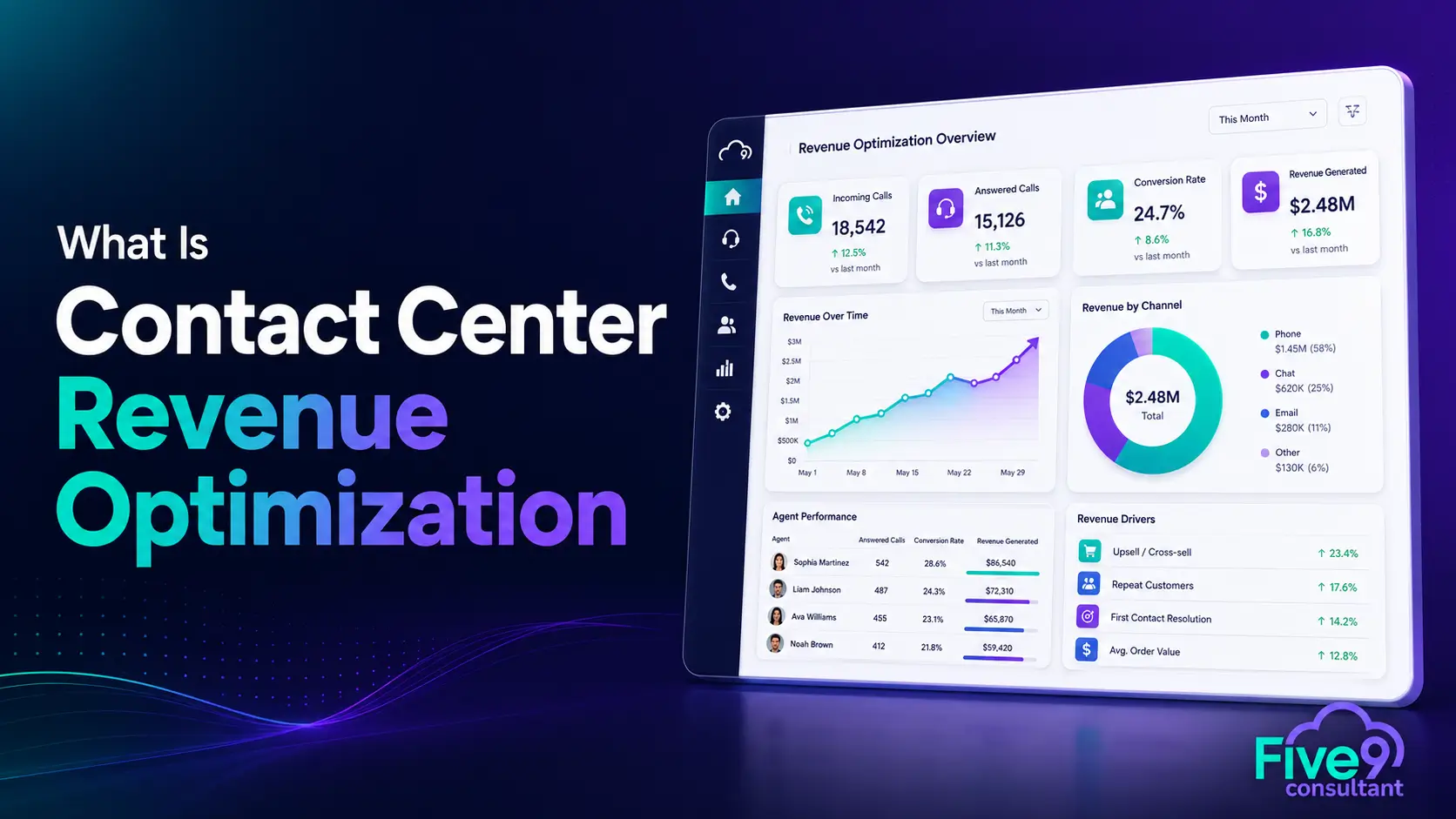
Key Takeaways:
- Contact center revenue optimization is the practice of turning contact center conversations, routing, data, and reporting into measurable revenue contributions instead of treating the contact center purely as a cost center.
- The work is operational, not theoretical: it changes how calls are routed, how outcomes are recorded, how agents are coached, and how contact data flows into your CRM.
- Most contact centers already have the licenses and features needed. The gap is usually configuration, data hygiene, and missing integrations rather than missing software.
- Revenue leakage typically hides in five places: abandoned calls, poor routing, inconsistent dispositions, unfollowed callbacks, and disconnected CRM records.
- Clean disposition data and CRM integration matter more than any single dashboard, because attribution is impossible without them.
- Start with an audit of your current platform configuration and reporting before buying new tools, then prioritize the fixes tied to the largest revenue impact.
Most contact center leaders inherit a system built for efficiency. The queues answer calls, the reports show handle time, and the budget conversation focuses on cost per contact. That setup works until leadership asks a harder question: how much revenue does the contact center actually produce? Contact center revenue optimization exists to answer that question and then improve the number.
This article explains what contact center revenue optimization means, how it works in practice, which levers matter most, who benefits from it, and what mistakes stall the effort. If you run a Five9 environment, the same principles apply directly to your existing configuration.

What Is Contact Center Revenue Optimization?
Contact center revenue optimization is the process of reconfiguring contact center operations, technology, and data so that customer conversations measurably contribute to pipeline, conversion, retention, and revenue. It combines routing strategy, agent enablement, automation, CRM integration, and outcome reporting into one system where every interaction is tracked against a business result.
The definition matters because the term is often confused with two other things. It is not workforce optimization, which focuses on scheduling and adherence. It is not simply sales coaching, which improves individual conversations without changing the underlying system. Revenue optimization sits above both. It asks which interactions create value, which ones leak value, and what configuration changes close the gap.
A practical way to frame it: cost optimization asks how to handle the same volume with fewer resources. Revenue optimization asks how to convert the volume you already have into more closed business, higher retention, and better lifetime value. Both are legitimate goals, but they lead to very different technical decisions.
For a deeper walkthrough of how this applies to a specific platform, the Five9 Revenue Optimization: The Complete Guide to Turning Your Contact Center Into a Revenue Engine covers the full framework in detail.
How Does Contact Center Revenue Optimization Work?
Revenue optimization works by connecting three layers that usually operate separately: the conversation layer, the data layer, and the decision layer. When those three layers align, you can trace a phone call or chat session to a revenue outcome and then improve the path.
Step 1 — Audit the Current Configuration
Every engagement starts with an honest look at what the platform does today. That means reviewing IVR paths, queue logic, skill assignments, disposition lists, callback rules, integration status, and report definitions. This audit almost always surfaces surprises, such as skills that no longer map to real teams or disposition codes that agents ignore.
Step 2 — Fix the Data Foundation
Attribution depends on clean data. If agents choose from forty disposition codes with overlapping meanings, no report will be trustworthy. Standardizing outcome codes, mapping them to revenue stages, and syncing them to the CRM is unglamorous work that unlocks everything downstream. Our guide on Five9 Call Dispositions: Best Practices for Sales and Support Teams breaks down how to structure these codes properly.
Step 3 — Route for Value, Not Just Availability
Traditional routing sends the next call to the next available agent. Revenue-aware routing considers customer value, intent, account history, and agent skill. A renewal call from a high-value account should not land with a newly onboarded agent simply because that agent happened to be free.
Step 4 — Measure, Coach, and Iterate
Once outcomes are visible, supervisors can coach against results rather than impressions. Dashboards, alerts, and scorecards turn the data into daily decisions. The article on Use Five9 Dashboards to Monitor Agent Performance and Drive Results explains how to build that visibility layer.
Why Contact Center Revenue Optimization Matters
The contact center touches customers at the highest-intent moments in their journey. Someone calling about pricing, cancellation, delivery, or upgrade eligibility is already engaged. When those conversations are handled through a system designed only for speed, high-intent moments get treated the same as routine ones.
Revenue optimization matters for four practical reasons.
- Intent is already present. Inbound contacts represent demand you have already paid to generate through marketing, referrals, or brand equity.
- Attribution changes budget conversations. When you can show contact center contribution to the pipeline, the platform stops being a line item to cut and becomes an investment to fund.
- Small conversion gains compound. Contact centers handle high volume, so modest improvements in save rates or qualification accuracy accumulate over a year.
- Customer experience and revenue align. Faster resolution, better routing, and informed agents improve satisfaction and revenue at the same time, which the analysis in The ROI of Five9 When Integrated Correctly explores in depth.
None of this guarantees a specific financial result. Outcomes depend on your volume, margins, market, and how thoroughly the changes are implemented. What optimization does guarantee is visibility, and visibility is the prerequisite for improvement.
Who Needs Contact Center Revenue Optimization?
Contact center revenue optimization is most valuable for organizations where the contact center already handles commercially meaningful conversations. That includes several clear profiles.
- Growth-stage companies scaling from a small support team to a structured contact center, where early configuration decisions were made quickly and never revisited.
- Sales-driven contact centers running outbound campaigns, inbound qualification, or hybrid motions where conversion rate directly drives revenue.
- Subscription and renewal businesses where retention calls, cancellation saves, and upgrade conversations carry direct financial weight.
- Organizations with a CRM disconnect, where call activity lives in one system and opportunity data lives in another with no reliable link between them.
- Teams under cost pressure that need to demonstrate contribution rather than just defend headcount.
If your contact center handles only low-stakes informational queries with no commercial component, revenue optimization is a lower priority than straightforward efficiency work. The honest test is simple: if you cannot currently answer how many contacts led to a closed opportunity last quarter, you have a measurement gap worth closing.
The Core Levers of Contact Center Revenue Optimization
Optimization work concentrates on a handful of levers that consistently produce results. Each one is a configuration decision rather than a new purchase.
Intelligent Routing and Prioritization
Routing decides who talks to whom, and that decision shapes the outcome before a word is spoken. Priority rules based on account tier, deal stage, product line, or renewal date direct high-value conversations to the agents most equipped to handle them.
IVR and Self-Service Design
A well-designed IVR resolves simple requests without an agent while identifying intent early for everything else. A poorly designed one buries high-intent callers under menu layers and drives abandonment. The practical setup steps appear in How to Set Up Effective IVR Systems in Five9 for Better Call Center Performance.
CRM Integration
Integration is the single highest-leverage item on this list. When contact records, call outcomes, recordings, and dispositions write back to the CRM automatically, attribution becomes possible and agents stop working blind. A Guide to the Ultimate Call Center Stack with Five9 and Salesforce covers how that integration is structured.
AI and Automation
Virtual agents deflect repetitive contacts so human agents concentrate on revenue-bearing conversations, while agent assist surfaces context in real time. The mechanics are explained in Five9 AI & Automation: The Complete Guide to Virtual Agents and Agent Assist and the customer experience effects in How AI-Powered Virtual Agents Transform Contact Center Customer Experience.
Outcome Reporting and Alerts
Real-time reporting turns problems into interventions. An alert on an abandonment spike or a stalled callback queue lets a supervisor act while revenue is still recoverable, as described in How to Build Real-Time Call Reports and Alerts in Five9.
Common Mistakes That Block Revenue Optimization
Most stalled optimization efforts fail for predictable reasons. Recognizing them early saves months.
- Buying features before fixing configuration. New licenses rarely solve problems caused by routing logic and data hygiene.
- Tracking activity instead of outcomes. Call volume and talk time describe effort, not results.
- Letting disposition lists grow unchecked. Every added code without governance reduces reporting accuracy.
- Treating integration as an IT project. Integration decisions are revenue decisions and need commercial input.
- Optimizing one channel in isolation. Customers move between phone, chat, and email, and disconnected channels break the record of the relationship. The approach in Use Five9 to Power Omnichannel Customer Experiences that Drive Loyalty addresses this directly.
- Skipping agent enablement. Configuration changes fail when agents are not trained on what changed and why it matters.
- Measuring too soon. Give changes a full reporting cycle before judging them, and compare against a defined baseline.
Broader operational fixes that support this work are covered in 7 Proven Strategies to Improve Contact Center Performance With Five9.
Turn Your Existing Contact Center Into a Revenue Engine
You do not need to replace your platform to start capturing more value from it. In most environments, the licenses, channels, and reporting capabilities are already in place, and the opportunity sits in how they are configured, connected, and measured.
If you want a structured path from your current setup to a revenue-aware one, review the Five9 Revenue Optimization service page to see how an audit, roadmap, and implementation engagement typically work. It outlines what gets reviewed, what gets rebuilt, and how progress is tracked against your own baseline rather than generic benchmarks.
Speak With a Five9 Consultant About Your Revenue Goals
Every contact center carries a different mix of volume, channels, integrations, and constraints, so the right starting point depends on your specific configuration and commercial priorities. A short conversation is usually enough to identify where the largest gaps sit.
Share your current setup and goals through the Five9 Consultant contact form, and you will get a direct assessment of which optimization steps make sense first for your environment. There is no obligation to proceed beyond that conversation.
Final Thoughts
Contact center revenue optimization reframes a familiar operation. Instead of asking how cheaply you can handle contacts, it asks how much value those contacts create and what configuration changes increase it. The work is concrete: audit the platform, clean the outcome data, route by value, integrate with the CRM, automate the repetitive volume, and report on results rather than activity.
The organizations that benefit most are the ones that start with measurement. Once you can trace a conversation to a commercial outcome, every subsequent decision becomes easier to justify and easier to improve. Begin with an audit of what you already own, prioritize the fixes tied to the largest gaps, and build from there.